
Built-in inflation
The built-in pump inflates the tent body and stops automatically. Secure the tent with stakes and guy lines before use.
LINKSOLAR SOLAR TENTS
Compare our 52W and 120W inflatable camping tents. Choose room for 2–3 or 3–4 people, with a built-in pump and an optional removable solar roof.
Compare solar tents
CHOOSE YOUR SOLAR TENT
Start with sleeping space, then choose Tent Only or Tent + Solar Roof. Both models use inflatable TPU air beams and a built-in pump.
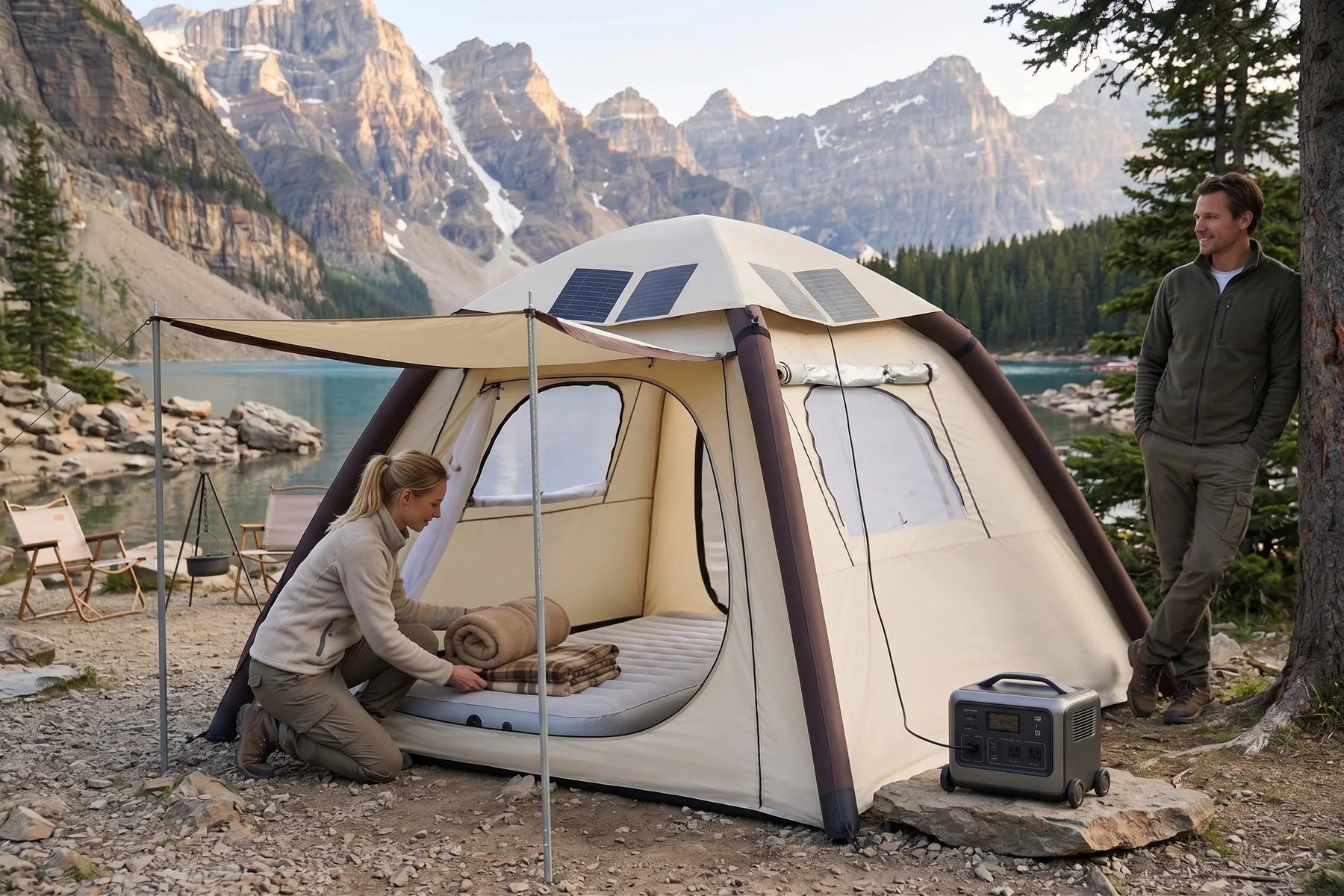 For 2–3 campers
A compact 200 × 200 cm footprint for weekend car camping, with an optional removable 52W solar roof.
Explore the 52W tent → For 3–4 campers
More floor space and a 190 cm peak height, with an optional 120W roof made from twelve 10W panels across four sides.
Explore the 120W tent →Scene accessories are not included. Each tent includes two complete awning poles; setups showing more poles require additional poles.
| Choose by | 52W tent | 120W tent |
|---|---|---|
| Recommended capacity | 2–3 people | 3–4 people |
| Length × width × height | 200 × 200 × 170 cm | 230 × 230 × 190 cm |
| Floor area | 4 m² | 5.29 m² — about 32% larger |
| Optional solar roof | 52W rated panel power | 120W total: 12 × 10W panels |
| Packages | Tent Only / Tent + Solar Roof | Tent Only / Tent + Solar Roof |
| Tent-body inflation | Under 3 minutes; built-in pump | Under 3 minutes; built-in pump |
| Junction-box port limits | USB-A: 18W; USB-C: 18W; DC5521: 50W | USB-A: 18W; USB-C: 18W; DC5521: 50W |
Capacity depends on sleeping gear and luggage. Solar ratings are not continuous output guarantees or USB charging speeds. Roof installation, staking and guy lines are additional setup steps.
SHARED CAMPING ESSENTIALS
Choose your preferred size without giving up the built-in pump, air-beam structure or removable-roof design.
The built-in pump inflates the tent body and stops automatically. Secure the tent with stakes and guy lines before use.
Both sizes use TPU air beams for their main structure, with the same smart-stop pump design.
Both tents have a 4000 mm waterproof rating. Keep the junction box, charging ports and connected electronics dry.
Choose the solar-roof package to collect available sunlight. Fit the separate roof by hand after inflating the tent body.
QUICK CHOICE GUIDE
Match your shelter to your group, then decide how you want to use sunlight.
Read the Solar Lab comparison →For 2–3 campers who prefer a compact footprint. Check your mattress dimensions and allow room for bags before choosing.
For 3–4 campers, or a smaller group wanting extra floor space and headroom. Its larger solar roof increases rated panel capacity; the junction-box port limits remain the same.
Choose Tent + Solar Roof and bring a compatible power bank or power station to store daytime energy. Tent Only does not include solar panels, and neither package includes solar energy storage.
SOLAR TENTS FAQ
Clear answers about setup, solar charging and what comes with your tent.
Visit Support for setup and care →The 52W model measures 200 × 200 × 170 cm and is recommended for 2–3 people. The 120W model measures 230 × 230 × 190 cm and is recommended for 3–4 people. The larger model has an optional 120W roof made from twelve 10W panels; both share the inflatable air-beam structure, built-in pump and junction-box port limits.
No. Choose Tent + Solar Roof for solar charging. Tent Only includes the inflatable shelter and its standard accessories, without the solar roof. Check your selected package on the product page before ordering.
The solar roof connects to a junction box with USB-A, USB-C and DC5521 outputs. Compatible phones, power banks and small USB camping devices can charge when sunlight is sufficient. A compatible power station may use the DC output; check its input voltage, polarity, connector and cable requirements first.
No. 120W is the combined solar-panel rating. On both models, USB-A supports up to 18W, USB-C up to 18W and DC5521 up to 50W. These individual port limits should not be added together as a guaranteed simultaneous output. Actual charging depends on sunlight, roof orientation, shade, temperature and the connected device.
Yes, if you first store daytime energy in your own compatible power bank or power station. The solar roof does not generate power at night and has no built-in energy storage. The pump battery is for inflation, not for powering your camping devices.
The under-three-minute figure refers to tent-body inflation using the built-in pump. Positioning the tent, staking, securing guy lines and manually fitting the optional solar roof take additional time.
No mattress, power station, power bank, furniture or charging devices are included. Each tent includes two complete awning poles (six sections in total). Images showing more than two poles illustrate setups that need additional poles. See the product page for the complete packing list.
Keep the junction box, plugs and connected electronics dry. A 4000 mm tent waterproof rating does not mean exposed electrical connections can be immersed or left unprotected. Follow the setup and care instructions and secure the tent for the conditions.
Compare the two tents, then choose your package on the product page. Current prices, availability and full specifications are shown there.
Compare the two tents