
Fit after inflationPosition and fasten the separate solar roof by hand.

Solar roof included with the solar package only. Includes 2 awning poles; extra poles shown are not included. Mattress, furniture and power station shown are not included.
LINKSOLAR / Solar camping
120W Solar-Ready Inflatable Camping Tent
More room to camp. A roof that does more.
A 3–4 person inflatable camping tent with TPU air beams, a built-in smart-stop pump and a 1.9 m peak height. Choose the removable 120W solar roof for compatible daytime charging.
Optional 120W solar roof3–4 person spaceBuilt-in smart-stop pump4000 mm waterproof rating
$369.00 USD
Tent + 120W Solar Roof
Includes the removable 120W roof and junction box. Solar generation only; compatible external storage is sold separately.
The pump battery powers inflation only. Mattress, furniture, power banks, power stations and extra awning poles are not included.
Two clear packagesChoose shelter or solar
Dongguan warehouseChina fulfillment
Product supportAsk about compatibility

A bigger base for shared weekends
Room to settle in.
Power to stay connected.Room for your weekend.
Take a little more space into the outdoors. An inflatable shelter for 3–4 people, with an optional solar roof for your everyday camping essentials.Space for 3–4 campers, with an optional 120W solar roof.
Explore the solar roofCampsite scene for illustration. Mattress, furniture and power equipment are not included.
120WOptional solar roof
3–4Recommended campers
1.9 mPeak height
< 3 minBody inflation*
12 panels. Four sides. One removable roof.
Turn your campsite roof into a solar charging surface.
Three 10W panels on each of four sides make up the 120W solar roof. The panels feed a shared junction box, bringing charging connections to one place rather than requiring separate connections for each side.
Practical details
Keep phones, compatible power banks and rechargeable camping essentials topped up while sunlight is available. Roof-mounted panels use space already occupied by the shelter, so a separate ground-level solar panel is not required for this package.
120W is the combined panel rating, not a promise of continuous output. Different roof faces receive different sunlight as the sun moves. Trees, cloud, temperature and the connected load also affect the energy you collect.
120Wtotal rated solar-panel power
Solar functions apply only to Tent + 120W Solar Roof. No built-in solar energy storage.
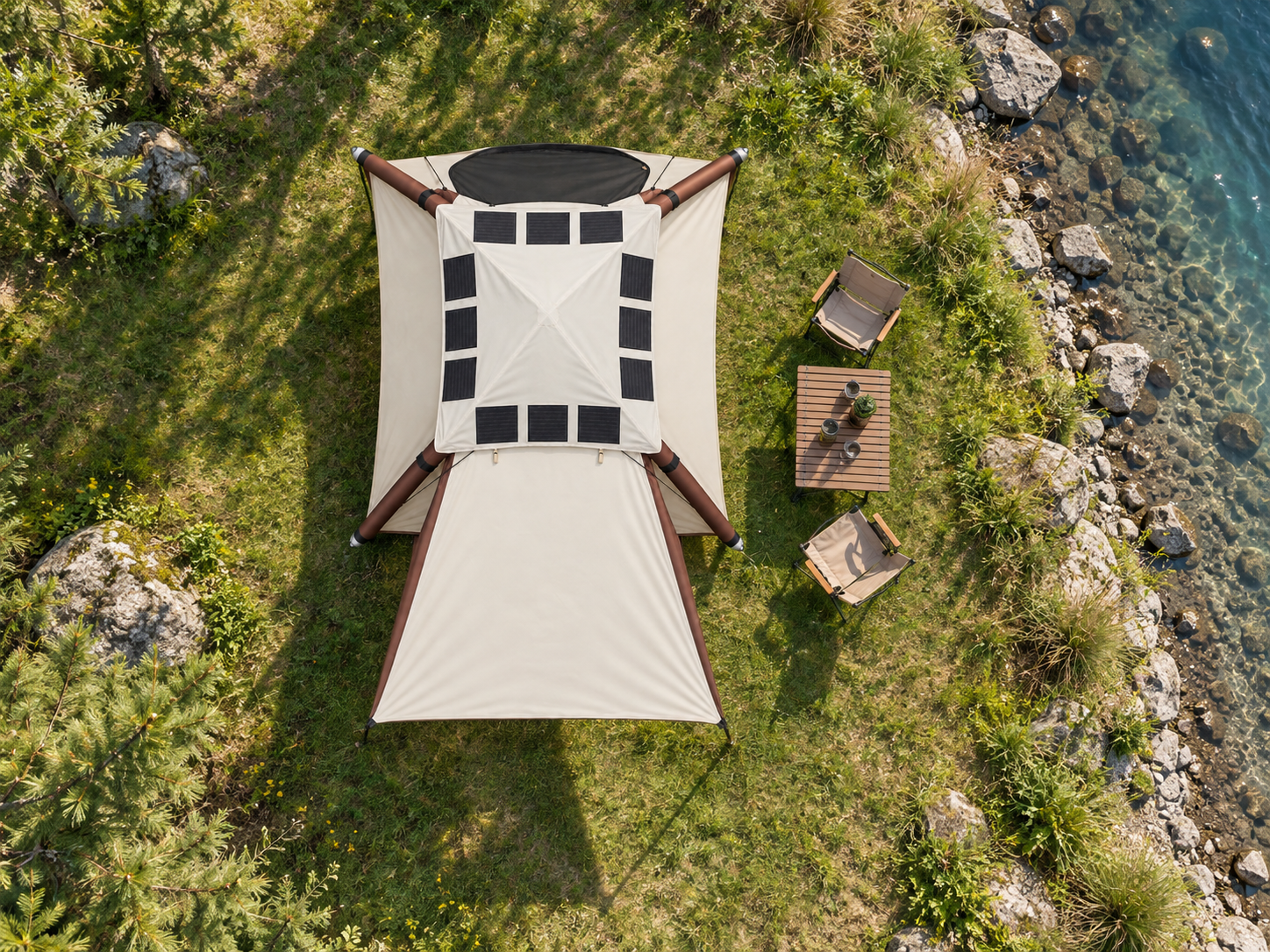
From sunlight to useful power
Fit the roof. Connect your gear.
The tent provides the shelter first. Add the removable 120W solar roof after inflation, route its single lead to the junction box, and choose the output that matches your device.
Connect and chargePlug the DC7909 roof lead into the junction box, then select a compatible output.
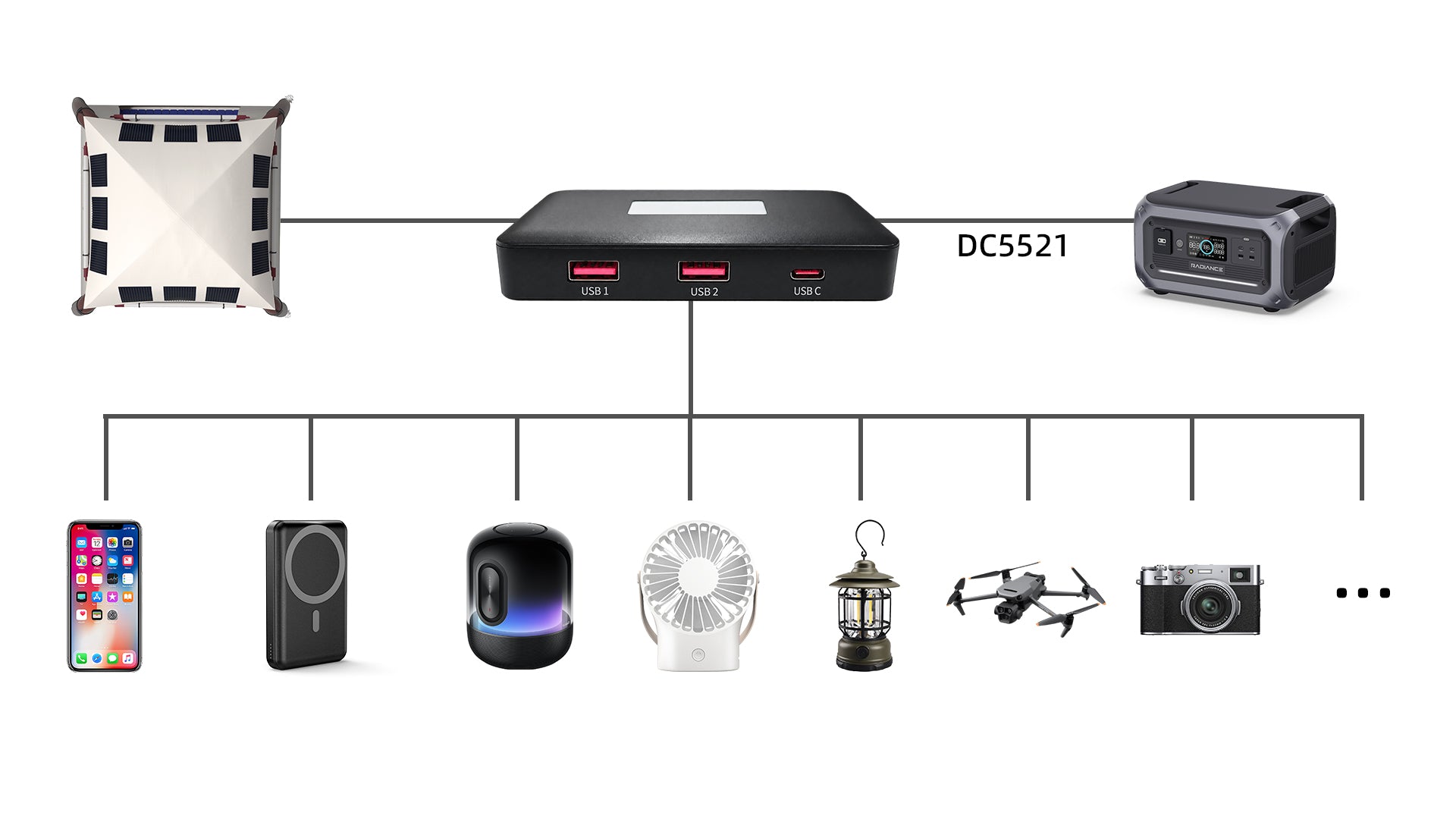
Up to 18W each
Up to 18W
Up to 50W
120W is the combined panel rating, not the maximum of one output. Output depends on sunlight and connected equipment. Check device voltage, polarity, current and charging-protocol requirements before use. No battery or AC outlet is built in.
Field data, with context
What could a day of solar energy do?
370Wh/day
Brand-reported 45-day average in Dongguan, measured after the junction box.
Phone charges
5000mAh · 3.85V
Power-bank charges
10000mAh · 3.7V
5W camping light
Energy equivalent
10W compact fan
Energy equivalent
Weather, shade, season, roof orientation and connected loads change the energy collected. These are calculated energy equivalents, not device-charging test results or guaranteed daily performance.
Calculation, assumptions and a sample weekend energy budget
Starting with 370Wh measured after the junction box, an illustrative 80% downstream efficiency leaves 296Wh for device batteries or loads. Divide 296Wh by device battery energy or operating power. Actual efficiency is not yet measured for these examples.
Each figure uses the full 296Wh independently; do not add them together. Four phone charges, a 5W light for 8 hours and a 10W fan for 8 hours total approximately 197Wh at the devices. Use after daylight requires compatible external storage, purchased separately.

Collect by day. Use stored energy later.
The roof generates electricity; a compatible user-owned power bank or portable power station stores it for lights, fans, phones and other suitable devices after sunset.
No solar storage is built into the tent. Storage and devices shown are not included.Press the button. Watch your shelter rise.
Built-in inflation, with an automatic stop.
The integrated electric pump fills the TPU air beams, removing the need to connect a separate external pump for normal setup. Start with a charged pump battery and a correctly closed deflation valve.
< 3 minTent-body inflation5.8–6 PSIAutomatic stop
The three-minute claim covers body inflation only. Ground preparation, staking, guylines, awning and roof fitting take additional time.
TPU air-beam construction
A firm inflatable frame, without long rigid tent poles.
The tent’s inflatable frame uses TPU air chambers with a protective outer construction. Inflated beams form the main shelter structure, while separate sectioned poles support the extended awning.
Practical details
TPU brings a flexible, low-odor material to a frame designed to fold down for transport. Correct inflation gives the beams their supporting shape; the frame still depends on properly placed stakes and tensioned guylines.
Protect the beams from sharp objects and keep valves clean. An inflatable structure is not puncture-proof. If it loses firmness, check the valve closure and inspect for damage before continuing to use it.
Automatic stop: approximately 5.8–6 PSI. Maximum safe pressure: 7 PSI.

Space for the people you camp with
A 2.3 m square footprint. A 1.9 m peak.
The tent body measures 230 × 230 × 190 cm—approximately 90.6 × 90.6 × 74.8 inches. Its nominal floor footprint is 5.29 m², or about 57 sq ft, giving a small group room to arrange sleeping pads and overnight essentials.
Practical details
The 1.9 m dimension is the peak height. Sloping walls reduce standing headroom toward the edges. Mattress size, the number of adults and the amount of luggage all change how spacious the tent feels.
For a four-person trip, check your actual pad widths before packing: four 60 cm-wide pads would need 240 cm side by side, wider than the tent’s 230 cm footprint. Use a layout that fits your group rather than assuming every four-person bedding arrangement will fit.
3–4 peoplerecommended capacity; check your sleeping layout
The extended awning is outdoor shade space, not additional enclosed sleeping floor area. Mattress not included.

Open up your corner of the outdoors
Two doors, two windows and a top mesh opening.
Adjust the opposing doors and side windows to suit your campsite. Along with the top mesh window, the five openings support airflow through the shelter while mesh provides an insect barrier when correctly closed.
Practical details
Extend an awning for a shaded entrance and a place to pause outside. The standard kit includes two complete awning poles assembled from six sections. Multi-awning arrangements in photos may require extra poles.
Ventilation helps manage warm air and moisture but cannot eliminate condensation in every condition. Keep suitable openings ventilated when weather allows and dry the tent thoroughly after your trip.
Extra poles, mattresses, furniture and other campsite props shown are not included.

Ready for changing campsite conditions
4000 mm waterproof protection, with the details that matter.
The tent carries the same confirmed 4000 mm waterproof rating as the 52W model. Taped-seam construction supports weather protection, while correctly closing doors and windows helps keep wind-driven rain outside.
Practical details
Choose level, well-drained ground, secure the tent with its stakes and guylines, and avoid spots where water can collect. Recheck tension as conditions change. A waterproof rating is not a guarantee against flooding or severe storms.
Keep the junction box, plugs and connected electronics dry and sheltered. The tent-fabric waterproof rating does not establish an immersion rating for electrical equipment. The tent is not intended as protection during severe or extreme weather.
Rain scene is illustrative, not a photograph of a controlled waterproof test.

Pack down. Head home. Go again.
A carry bag sized for the next car-camping trip.
The tent body and solar roof together weigh 9 kg, approximately 19.8 lb. The removable solar roof accounts for 2 kg of that total. Including the shipping carton, the solar package weighs approximately 9.5 kg.
Practical details
This is a shelter for car camping and trips with short carries from the vehicle, rather than an ultralight backpacking tent. Check your available luggage space and allow room for sleeping gear and any separate energy-storage equipment.
Dry the fabric before long-term storage. Fold the solar roof carefully, keep its connectors clean, and store the charged pump battery according to the product instructions.
55 × 24 × 24 cmpacked dimensions · approx. 21.7 × 9.4 × 9.4 in
9 kg describes the tent body plus solar roof, not the Tent Only shipping weight.


Packed for delivery
The shipping carton.
The carry bag.
The outer shipping carton measures 60 × 25 × 28 cm (approximately 23.6 × 9.8 × 11.0 in). This is the delivery packaging, separate from the tent’s 55 × 24 × 24 cm packed carry-bag dimensions.
The tent body and solar roof together weigh 9 kg. With the shipping carton, the solar package weighs approximately 9.5 kg.
After your stay
Release. Roll. Pack.
Open the valve, let the air-beam body settle, then fold and roll toward the valve so residual air has a clear way out.
- Remove the solar roof and awning poles.
- Open the deflation valve counter-clockwise.
- Fold into a quarter-size rectangle.
- Roll from the pump end toward the open valve.
- Strap, bag and dry fully before storage.
One color. Two ways to camp.
Choose shelter.
Or shelter with solar.
Both packages use the same beige tent, TPU air beams and built-in pump. Select the solar package if daytime charging is part of your camping plan.

Tent Only
$246.00 USD
- Beige inflatable tent with built-in pump
- Rechargeable pump battery
- 2 awning poles (6 sections total)
- 10 stakes and 10 guylines
- Carry bag and instructions
No solar roof, solar junction box or solar charging.
Choose Tent Only ↗
Tent + 120W Solar Roof
$369.00 USD
- Everything in the Tent Only package
- Removable 120W solar roof
- 12 panels: 3 × 10W on each of 4 sides
- Solar junction box
- Compatible daytime charging connections
No power bank or portable power station. Solar generation only.
Choose the solar package ↗Know what is in the bag.
The included battery powers the pump only. Six pole sections assemble into two complete awning poles. Multi-awning setups shown may require extra poles, which are not included.
Mattresses, furniture, lights and other campsite props shown are not included. The solar roof and junction box belong only to the solar package.

Find your fit
52W or 120W: what changes?
| Feature | 52W model | 120W model |
|---|---|---|
| Rated solar roof power | 52W | 120W · 12 × 10W panels |
| Tent-body dimensions | 200 × 200 × 170 cm | 230 × 230 × 190 cm |
| Recommended capacity | 2–3 people | 3–4 people |
| Nominal floor footprint | 4.00 m² | 5.29 m² · about 32% larger |
| Frame and inflation | TPU air beams; built-in pump | TPU air beams; built-in pump |
| Individual output limits | USB-A 18W / USB-C 18W / DC 50W | USB-A 18W / USB-C 18W / DC 50W |
| Solar energy storage | External storage required | External storage required |
Solar roof specifications apply to solar packages. The larger panel rating does not mean proportionally faster charging at an unchanged output port. Explore the 52W tent.
The details, all together
Know your tent.
Dimensions, weights and charging limits refer to different parts of the kit. Check the package you select before ordering.
Packed: 55 × 24 × 24 cm. Solar package shipping weight: approximately 9.5 kg including its carton.
- Color
- Beige
- Recommended capacity
- 3–4 people; check your sleeping-pad layout
- Tent-body dimensions
- 230 × 230 × 190 cm / 90.6 × 90.6 × 74.8 in
- Packed dimensions
- 55 × 24 × 24 cm / 21.7 × 9.4 × 9.4 in
- Shipping carton dimensions
- 60 × 25 × 28 cm / 23.6 × 9.8 × 11.0 in
- Tent + solar roof weight
- 9 kg / 19.8 lb; excludes shipping carton
- Solar roof weight
- 2 kg / 4.4 lb; included in the 9 kg total
- Solar package shipping weight
- Approximately 9.5 kg / 20.9 lb including carton
- Solar-panel configuration
- 4 sides × 3 panels × 10W = 120W rated total
- Roof connection
- DC7909 to the junction-box input
- Junction-box outputs
- 2 × USB-A, up to 18W each; USB-C up to 18W; DC5521 up to 50W
- Solar energy storage
- Not included; requires compatible external storage
- Air-beam material
- TPU
- Inflation
- Built-in pump; tent-body inflation in under 3 minutes
- Pump automatic stop
- Approximately 5.8–6 PSI; maximum safe pressure 7 PSI
- Waterproof rating
- 4000 mm; electronics have separate protection requirements
- Ventilation
- Two doors, two windows and top mesh opening
- Awning poles
- 2 complete poles, 6 sections total
- Standard accessories
- Pump battery, 10 stakes, 10 guylines, carry bag and instructions
- Fulfillment
- Dongguan, China
Your camping questions, answered
Before you choose.
Before you pitch.
Practical answers about solar charging, sleeping space, inflation, weather protection and what comes with your tent.
Choosing your tent
What is a solar inflatable camping tent?
It combines an air-beam camping shelter with a solar charging option. This LINKSOLAR tent uses a built-in pump to inflate its TPU frame; the solar package adds a separately fitted 120W roof and junction box. It supplies solar electricity in sunlight, but neither the roof nor the tent stores that energy.
What is the difference between the two packages?
Both packages include the same beige 3–4 person tent, built-in pump, pump battery and standard shelter accessories. Tent Only costs $246.00 USD and has no solar roof or solar junction box. The $369.00 USD solar package adds the removable 120W roof and junction box. A power bank or portable power station is not included in either package.
How does the 120W model differ from the 52W tent?
The 120W tent has twelve 10W panels across four roof sides and a larger 230 × 230 × 190 cm body. The 52W model measures 200 × 200 × 170 cm and is recommended for 2–3 people. Both use TPU air beams, a built-in smart-stop pump and a manually fitted removable solar roof. More panel capacity does not increase the individual junction-box port limits.
Can four adults sleep inside?
The recommended capacity is 3–4 people, depending on body size, sleeping pads and luggage. Check your bedding against the 230 × 230 cm nominal footprint. Four 60 cm-wide pads will not fit side by side across 230 cm. A couple or three campers may prefer the extra space for gear; the awning is not enclosed sleeping space.
Can I stand up inside the tent?
The highest point is 190 cm, about 74.8 inches. Whether you can stand comfortably depends on your height and where you stand. The roof slopes, so the entire tent does not have 190 cm of clearance. Use the dimension diagram to assess your needs.
Is this a lightweight backpacking tent?
It is better suited to car camping, weekend campsites and short carries from a vehicle. The tent body plus solar roof weighs 9 kg, before the shipping carton. The packed dimensions are 55 × 24 × 24 cm. It is not positioned as an ultralight hiking or mountaineering shelter.
Solar and charging
How is the 120W solar roof arranged?
There are three 10W panels on each of four roof faces: 3 × 10W × 4 = 120W total rated panel power. The roof connects to one junction box. Since the faces point in different directions, their exposure changes through the day; the rating does not mean all panels continuously deliver their rated power at once.
Does the tent store solar electricity?
No. The roof generates electricity when sufficient light is available. To save energy for later, connect a compatible power bank or portable power station, purchased separately. Its charging input, supported voltage, current, connector and protocol must match the selected junction-box output. The inflation-pump battery is not solar-energy storage.
What can I charge at camp?
Compatible phones, power banks, rechargeable camping lights, small rechargeable fans, Bluetooth speakers and other low-power devices are possible uses. Check each device’s input requirements and the port rating first. A device category or matching plug alone does not prove compatibility; ask us if you are unsure about your exact device and cable.
What are the USB and DC output limits?
The junction box has two USB-A ports, a USB-C port and a DC5521 output. USB-A is rated up to 18W per port, USB-C up to 18W and DC5521 up to 50W. These are individual limits, not a promise that all outputs achieve their maxima simultaneously. Available sunlight and the connected equipment determine actual charging.
Why is the solar roof rated 120W if the DC output is 50W?
The figures describe different parts of the system. 120W is the combined rated power of the twelve panels; 50W is the maximum of the junction box’s DC5521 output. The panel rating does not override the box or device limits. This page does not claim a single 120W charging outlet or a verified higher-power bypass connection.
What are DC7909 and DC5521 used for?
The roof’s DC7909 lead connects to the junction-box input. DC5521 is an output on the junction box for compatible equipment. They have different roles and should not be treated as interchangeable. Confirm electrical compatibility as well as connector fit before connecting third-party equipment.
How much electricity does it generate in a day?
LINKSOLAR reports an average of approximately 370Wh per day from 45 consecutive days of testing in Dongguan, China. Energy was measured after the junction box using dedicated electronic test equipment. This is a brand-reported field average, not an independent certification or a guaranteed daily yield. Your site, season, shading and connected load can produce different results.
How many phone charges does 370Wh represent?
As an energy illustration, allowing 20% for losses after the junction box leaves about 296Wh. A phone with a 5000mAh battery at 3.85V holds about 19.25Wh, giving roughly 15 full-charge equivalents. This is a calculation, not a phone-charging test or a promise of 15 sequential charges in one day. Phone use, charge taper and storage losses change the result.
Can the solar tent supply electricity at night?
The solar roof does not generate useful charging power without suitable light. Charge a compatible external storage device during the day if you want to run supported lights or charge devices at night. Nighttime lighting in the photos uses a separate power source; that power source and the pictured lights are not included.
Does it charge on cloudy days or under trees?
Output may drop substantially with cloud cover or shade, and charging can slow or stop if the available power is too low. Select an open pitch with good sunlight where practical. Keep leaves and equipment off the panels. Do not expect the Dongguan test average at a shaded campsite or in a different season.
Can it run a heater, kettle, refrigerator or laptop?
The junction box is not an AC inverter and does not offer a household power outlet. Do not expect it to run high-power camping appliances. Laptop and refrigerator compatibility cannot be assumed from panel wattage; many require different voltages, higher power or a suitable external power station. Check the exact equipment specifications before buying.
Can I connect several devices at once?
The box provides several outputs, but each connected device shares the available solar input. Individual port maxima should not be added together as a guaranteed simultaneous rating. For multiple devices, check compatibility, allow for slower charging and prioritize essential loads when sunlight is limited.
Setup and care
Is the whole campsite ready in three minutes?
No. Under suitable conditions, the built-in pump inflates the tent body in under three minutes. Clearing the ground, placing stakes, tensioning guylines, assembling the awning and fitting the solar roof are separate manual steps. Allow time for these steps even when inflation itself is quick.
Do I need to bring a separate electric pump?
The tent has an integrated electric inflation pump and a dedicated battery. Charge and check that battery before leaving home. A separate external pump is not required for normal operation. This does not mean the pump battery powers phones, camp lights or the solar system.
What pressure should the air beams reach?
The built-in pump stops at approximately 5.8–6 PSI. The maximum safe air pressure is 7 PSI. Do not use that maximum as a routine inflation target or keep adding air after the normal automatic stop. Follow the product instructions and check the tent’s firmness and valve closure before use.
Is the solar roof permanently attached?
No. It is a separate removable part fitted by hand after the tent body is inflated and secured. Disconnect devices and remove the roof before deflating the tent. Fold it along its intended fabric sections rather than bending across the solar panels.
How do I deflate and pack the tent?
Remove the solar roof and awning poles, then turn the deflation valve counter-clockwise. Let the shelter settle flat. Fold it into a quarter-size rectangle with the pump end opposite the open valve, then roll from the pump toward the valve to push out remaining air. Strap the roll and place it in the carry bag. Dry fully before storage.
Will condensation form inside?
It can. Moist air from occupants and a cooler tent surface can create condensation even when rain is not entering. Use the doors, side windows and top mesh opening for ventilation when weather permits, and keep wet gear outside the sleeping space where practical. Ventilation reduces moisture buildup but cannot guarantee a dry interior in all conditions.
Is the tent waterproof, and are its electronics waterproof too?
The confirmed tent waterproof rating is 4000 mm. That rating does not automatically apply to the junction box, open plugs, charging cables or your devices. Keep electronics dry and sheltered, close openings appropriately in rain and avoid waterlogged ground. It is not a shelter for severe storms, flooding or extreme weather.
How many awning poles and accessories are included?
The standard kit contains two complete awning poles made from six sections, ten stakes, ten guylines, a carry bag and the pump battery, with the pump built into the tent. The solar package also includes the removable roof and junction box. Extra poles used to open additional sides in photos are not included.
Ordering
Are the mattress, furniture and power station included?
No. Mattresses, tables, chairs, portable power stations, power banks and other campsite props in the images illustrate possible setups. The solar roof is included only when you choose the solar package. Read the selected package contents before ordering.
Which colors are available and where does it ship from?
The 120W model is currently offered in Beige only, with Tent Only and Tent + 120W Solar Roof packages. Orders ship from Dongguan, China. Check the selected package for current availability. Shipping charges and delivery estimates depend on your destination.
How much does the solar package weigh?
The tent body plus solar roof weighs 9 kg (about 19.8 lb), including a 2 kg solar roof. With the shipping carton, the solar package is approximately 9.5 kg (20.9 lb). These are different weight definitions. The Tent Only shipping weight is not inferred from them.
How do I check a device before ordering?
Send LINKSOLAR the device model, its charging-input specifications and details of the cable you plan to use. Check voltage, current, power and charging protocol, not just the connector name. Contact support for the current delivery, returns and warranty terms rather than assuming terms from another brand or product.
Your next weekend starts here
A roomier place to unplug.
A way to keep essentials charged.Your next basecamp.
Choose the beige inflatable tent on its own, or add the removable 120W solar roof for compatible daytime charging.
Choose your package ↗Need help with a device connection? Contact LINKSOLAR support.